 |
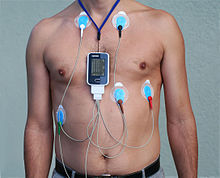
| Holter monitor Inventor: Norman Holter Source: Wikipedia |
About 15 years ago I fainted. It was the only time in my life that I fainted.
The reasons were probably, blood donation a day before, Work from 7:00 until 19:00 and participation in the the thirty-third day of the Omer period ceremonies of my children (I stood for a long time beside the traditional fire).
No problem found during The Medical Check up, I performed.
The Medical Check up included wearing an Holter Monitor recording my heart activity for 24 hours.
The Holter was a Wearable computing device, however nobody used the word Wearable.
If we exclude the enhanced computing power of current Wearables in comparison to the old Holter monitor, we can find two factor differentiating current Wearables from the Holter Monitor.
Size
The size of current Wearables is smaller than old wearables.This differentiating factor is not important.
Connectivity
This is a significant difference. If a device is connected via Internet it is part of Internet of Things.The Data collected by a wearable medical device could be loaded to a server in a Data center or in a Public Cloud.
The data could be analyzed in Near Real Time. If an immediate action is required, as a result of the analysis, e.g. finding dangerous patterns of variables recorded, the system could notify the one who wears the device immediately.
Operational Business Intelligence
Operational BI is used for Near real Time events analysis. For example, Fraud Detection in Banking. Every Bank has a Data Center (or is using a Data Center of a larger bank or is using another Company's Data Center).A back Hand Server software is usually responsible for data analysis and actions required as result of the analysis.
A human being is not connected to a Data Center. A Wearable device which is connected to the Internet and sends the measurements frequently, is enabler of Operational BI of human measurements.
In many cases the measurements are Health Care related. The Back End Server is capable of analysing the data and alerting events, similarly to a fraud detection events in a bank.
Rethinking my previous posts
In my previous post titled: Technology predictions for 2015: Trivial, Over Estimated and Interesting, I was sceptic about IDC's Wearable Computing prediction and classified it as Over Estimated.Unlike Wearables, I classified Internet of Things as revolutionary and interesting.
Be sure that I noticed that Wearables connected to the Internet are sub-class of Internet of Things, because I mentioned it in the post.
It seems that I think that Wearables are less important sub-class of Internet of Things and many of them are doomed.
During the days between writing the previous post and the current post, I read few articles that made me change my mind slightly.
The most important of them is: Wearable technology is breakthrough for Parkinson's.
The article is about Intel's advanced analytics team in Israel's new device for collecting, analyzing and transmitting a wealth of symptoms data.
My Take
So it seems that Health Care related Wearables, which are Internet Connected are not doomed. They can provide useful Operational Business Analysis functionality together with Analytic Engines placed in a Back End Server.I do not know if a Pavlet could provide or will be capable of providing similar information.
If a Pavlet will not be capable of providing that type of information, Health Care related Wearables are useful and even life saving devices.
That does not mean that Wearable devices like Apple Watch or Google Glass, which do not provide any Value, will not fail.
Comments