Bob Dylan's song in is about The Times They Are A-Changin'.
Information Technology Leading Vendors are also changing.
If a company does not adapt to changes it may not Survive or it may Survive but no longer as The Market Leader.
The first three sections of the post are about Computers Industry Revolutions. The fourth is about, the current revolution. The sections following these sections, are a discussion of Microsoft's Survival probability.
You can't compete with NCR
 |
| Thomas Watson Jr. Source: Wikipedia |
In 1956 I was in a kinder garden. In the beginning of the decade starting on 1970, I was working as a junior Computers Programmer: IBM was the Computers Industry Leader.
NCR is now a player in the Automatic Teller Machines, Retail Store Automation and Self-Service Kiosks markets. NCR is far from being an Information Technology Market Leader.
Teradata, which was acquired by NCR is a leader in the Data Warehouse Market.
Many young people's opinion is that IBM Mainframes are Dinosaurous. It is a Myth: The dinsaurous Myth.
IBM's Mainframe computers, which enabled it to displace NCR as the Computer Industry Leader, are still alive and kicking, but they are no longer IBM's leading product.
IBM is still a major player in the IT Industry and a Leader in markets such as: SOA, Integration, BPM and Business Intelligence.
Software and Personal Computers
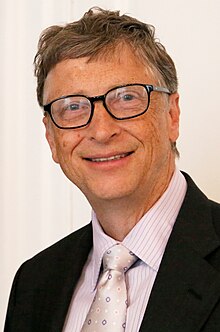 |
| Bill Gates Source: Wikipedia |
The significance of PCs was the ability of corporate and home users to execute applications on their personal computers instead of competing with other users on Mainframes and Mid Range Servers resources.
The shift from Hardware based revenues to Software based revenues model was a real challenge for the leading hardware vendors: IBM, HP and Dec. IBM and HP survived. DEC did not.
Microsoft with its Office suite and Windows Operating System was the new Information Technology Leader.
The World Wide Web
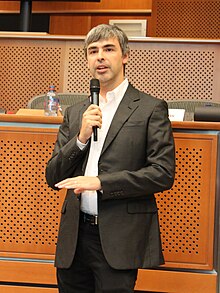 |
| Larry Page. Source Wikipedia |
The World Wide Web was the 90es revolution: You can access any data uploaded by anyone in the world. People could connect their PCs to Servers anywhere in the Web and use their computing resources and applications.
It has business implications as well: For example, Size was no longer the advantage of large companies only. A Web site with adequate application could unite a lot of users from anywhere consuming a service or buying a product.
The World Wide Web matured form a Web 1.0 to Web 2.0.
In the beginning of the decade of 2000, Google emerged as the WEB 2.0 Market Leader and gradually become the IT Leader.
Microsoft and IBM were still Market leaders in many market segments.
Cloud Computing and Consumerization
What was last years revolution? some people will say Smart phones. Others would say Big Data. No doubt, Smart phones and Big Data, are important technologies, but in my opinion the real revolutions are Consumerization and Cloud Computing.
Consumerization
The Consumer before the Enterprise technology model replaced the Enterprise before the Consumer model. New Technologies are applied to Consumers environment and only afterwards are assimilated in Enterprises.
smart Phones, Pablets and even Tablets are Consumerization enabling technologies. Wearables are also consumerization technologies.
Smart phones, Pablets and Tablets are the PCs of the future IT: they are Personal, but also small size and Mobile.
Cloud Computing
Public Clouds gradually replace in house computing infrastructure of SMBs. SMBs may not need Servers at all and use pre-built Saas applications.
Large Enterprises will use Hybrid Clouds.
Consumers Smart Phones, Pablets and Wearables will be connected to larger applications and Big Data located in a Public Cloud, few Public Clouds or Public Clouds and Private Clouds. Many of them are already connected to Clouds such as iCloud.
Will Microsoft Survive until 2023 - Revisited?
 |
| Satya Nadella Source: Wikipedia |
Less than two years ago, I wrote a post titled: Vendors Survival: Will Microsoft Survive Until 2023?.
I wrote that post because Steve Balmer stepped down as the CEO of Microsoft.
My Take paragraph included the following sentence: "It is too early to tell if the new CEO could change the non-Innovative giant company to more Agile Innovative company".
It looks like something was changed after Satya Nadella was selected to be Microsoft's CEO.
Nadella's background is different from Bill Gates's background and Steve Balmer's background. He was born and raised in India and migrated to USA.
He was working with Sun Microsystems as a member of its technology staff prior to joining Microsoft.
He had to adapt to another culture in order to succeed in education and in his career in USA.
He add to adapt to Microsoft's Organizational Culture and Business approach which was very different from Sun Microsystems Culture and Business attitude.
He was not employed only by the Leading IT vendor and therefore should be more open to other approaches.
If you read the article about him in Wikipedia, you will discover that he led Microsoft's move to Cloud Computing and "he was credited for helping bring Microsoft's Databases, Windows Servers and development to its Azure cloud".
Cloud first strategy
No wonder that Nadella coined the Cloud first strategy emphasizing Azure and Cloud Services.
I do not know if the strategy is a byproduct of his Cloud Computing background or his Cloud Computing successful roles promoted him to the CEO role.
Anyway, as you already read in previous section titled: "Cloud Computing and Consumerization" this strategy is in the right direction.
Mobile first strategy
Mobile first strategy could be also a strategy following the market trends. As far as execution of the strategy is concerned, probably it is not executed as well as the Cloud first strategy.
Open Source
15 years ago, I participated in TV debate about Open Source. I was advocating Open Source as a viable approach. The other participant was a CXO of Microsoft's largest partner in my country. He told the audience why Open Source is not as good as Close Source i.e Microsoft's products.
15 years ago, Microsft's strategy was based on binding customers to its products, mainly to Windows, Office and .net development environment.
Microsoft was changed in the last years and it supports Open Source and other vendors products. For example, read: Windows Azure and new Oracle DB up in a tree.
Mark Hachman, PC World's senior editor analyzed Microsoft's fourth quarter of 2014 results, which exceeded analysts expectations. However, Windows results were less good than expected.
In an article titled: In Microsoft 's mobile-first cloud-first strategy Windows take a supporting role, He asked: "Can Microsoft afford to make Windows free?"
The Bottom Line
Microsoft is better adapting to the new Information Technology revolution than before. Its new CEO Satya Nadella should be credited for this change.
The probability that it Survive until 2023 was high probability. It is higher probability than the probability I assigned to its survival before Steve Balmer stepped down as its CEO.
Comments