 |
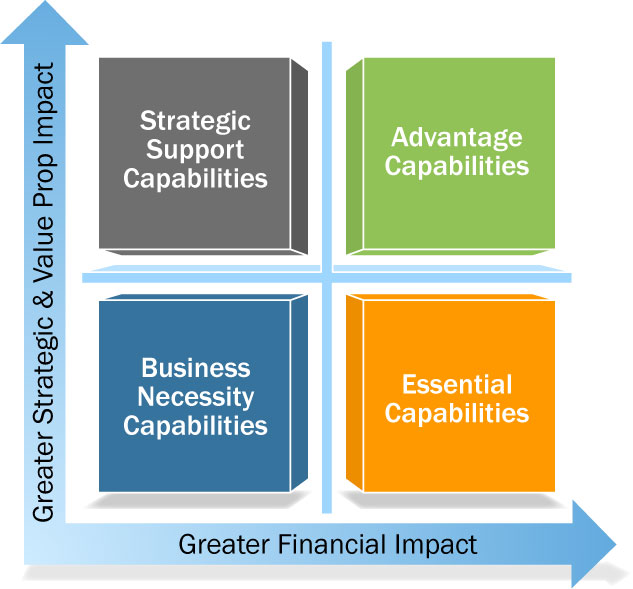
| Capability Analysis Source: English Wikipedia |
Micro Services is a new architectural style based upon independent Services.
The terms Micro Services and Micro Services Architecture are often used. It is an architecture based on independent relatively small components named Micro Services.
Some people may think that Micro Services Architecture is a new and improved Service Oriented Architecture (SOA). It is not.
Martin Fowler is the first name mentioned in articles about Micro Services. Fowler is a British Software Engineer specialized in Software development.
I read the article: Microservices in Fowler's Web site. I am more confused about Micro Services characteristics after reading the article.
The article was written by James Lewis and Martin Fowler.
What Micro Service Architecture is and what Micro Service is?
The articles discussed the following characteristics of Micro Service Architecture and Micro Services:
1. It is a new Architectural style
OK, let's understand what is new and what is its Value Proposition.
2. "approach to developing a single application as a suite of small services"
Nothing to write home about. Remember Cool:Gen?
A leading Client/Server IDE. It was a leading Component Based Development (CBD) tool. Its first version was launch in 1987. It is easy to find other IDE tools which were available 15 years or twenty years ago and were based on CBD methodology.
The Services granularity is small, unlike the coarse grained granularity of SOA Services.
3. "each running in its own process and communicating with light weight mechanism, often an HTTP resource API."
This is a performance issue: is the Overhead of many Micro Services small enough?
I am sure that for large applications it is not, unless light weight communication mechanism is used.
Similarly, REST is preferred over SOAP because of better Performance and reduced Complexity.
4. The Micro Services are "independently deployable by fully automated deployment machinery"
It could be a good technical approach for Deployment and for Change Management.
5. Monolithic applications run a in a single process they are scaled by multiple instances. Each Micro Service is deployed under a different process. No need to multiple instances, so Change Management is simpler and less error prawn.
Monolithic Applications are not Silo Systems or Monolithic Applications in SOA context. In this article they refer to Server Side only applications, while in SOA context they include all layers: Server as well as Clients and Middleware.
As in previous section the focus is technical. By running each Micro Process under different process, Performance could be improved and Deployment and Change Management of each Micro Service is less dependent on other Micro Services.
6. "These services are build around Business Capabilities"
Now I am really confused. How componentization of Application could be related to Business Capabilities?
Capabilities and SOA Services
Capabilities are defined as Coarse grained Business elements. Capability Analysis is used for bridging between Business Architecture and Service Oriented Architecture.
Capabilities are Business entities defining what and not How the Organization could do something Valuable.
System Analysis in Service Oriented Architecture could use Capability Analysis. After defining the Capabilities, you could map each Capability to Services i.e. according to the frequently used definition of Capabilities, a Capability is more Coarse Grained than a Service.
How could a Capacity will be related to a Fine Grained entity such as Micro Service?
What is the relationship between an Inter-Application entity (Micro Service) and a Business Entity (Capability)?
I do not have adequate answers to those questions.
Even if you define Capability as a smaller Business entity mapped Many to One to SOA Service, i.e. few capabilities included in a Service, I am still confused about its relationship to Micro Services.
It should be noted, that some companies, defined Capability as a less Coarse Grained entity than a SOA Service.
The Bottom Line
Micro Service Architecture is a new architectural style using terminology and approach resembling Service Oriented Architecture. However, the scope of Micro Service Architecture is Inter-Application.
SOA scope is Enterprise and Virtual Enterprise. Virtual Enterprise may refer to Public Clouds and Hybrid Clouds, as well as other types of implementing some of the Applications or some of the Services outside the Enterprise boundaries.
SOA Services are defined by Business Services boundaries. The alignment of Micro Services to Business Services is not well defined.
My Take
Micro Service Architecture could be useful. It is a small scale SOA like Architecture within an Application. It should be compared to other approaches to defining and managing Application Components.
Service Oriented Architecture is defined in another level and is orthogonal to Inter-Application Architectural styles such as: Micro Services Architecture or OMG's CBD model.
Micro Service Architecture could be useful for Agile Software Development Methodologies. It completes the methodology by adding a development and deployment style.
Comments
Thanks,
AS