One of the main obstacles towards Customer Centric was lack of understanding of the dependency of Customer Centric approach on Multi-Channel Architecture.
Multi-Channel and the Customer
If you are Customer Centric, than a customer should be free to choose his/her preferred Channel.
The conclusion above is obvious to say, but not always easy to execute.
Less obvious, is the conclusions you can derive from the customer's choice.
For example, a Bank customer preferring the Internet channel provided more value than a customer who preffers the Branch Channel.
This conclusion is supported by internal data of successful banks in Europe and USA dated about 10 years ago.
Although, I do not have access to updated data, the hypothesis that this conclusion is still valid, is plausible.
Internet Channel users could use this channel because they are busy working and therefore earn more money. They also may use this channel because they are Internet Natives, i.e. young people.
Young people e.g. students may not be preferred bank customers now, but probably will have higher income and financial resources in the future.
Multi-Channels Architecture
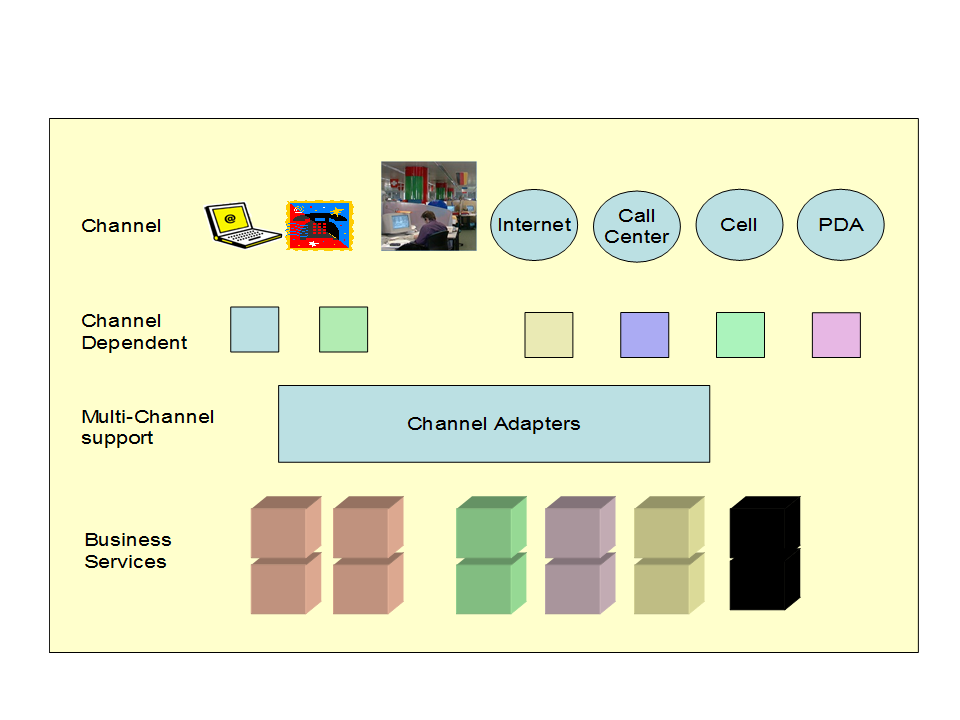
The illustration in the beginning of the post depicts Multi-Channel Architecture in an Enterprise SOA.
All channels share the same Business Services. However, there are also Channel Dependent Services, due to regulations, capabilities and limitations.
The most limited channel, ten years ago, was the Mobile phone.
Its limitations included: low bandwidth, small screen and less than optimal availability.
Some of the channels are used via communication with an employee (e.g. a Bank Branch Channel) and others are Self Service Channels.
As already noted about Internet Channel Bank Customers, Self Service Channel could be attractive to some customers. However, it is also attractive to Companies due to lower costs.
There are many Success Stories of SOA implementations enabling usage of Self Service Channels in addition to traditional Channels.
For example, Sprint-Nextel average Call cost in Self Service Channel was 43 cent instead of 12 USD in other Channels.
Another impressive SOA implementation is Verizon Wireless. The implementation is based upon BEA (now part of Oracle) SOA products. Usage of Self-Service Cellular Phone Channel by millions customers saved multi millions USDs, due to elimination of printing and sending reports by mail.
What was changed in Multi-Channel Architecture?
In my opinion, no fundamental change occurred in Multi-Channel Architecture in the last decade.
The major change was a change in the Mobile devices Channel: opportunities instead of limitation.
Smartphones and other devices applications are able to provide Location Dependent Services and other advanced services.
I guess that a study of Bank Customers Value according to their preferred channel will reveal that Customers preferring Mobile Devices Channel provide more value than other Channels users.
Another change is the possibility to execute parts of Customer - Company interaction from different Channels: For example, the Customer may start the interaction from his home Internet and will receive information and complete the transaction from his Mobile device.
CRM and Multi-Channels
Customer Relationship Management is not only usage of a CRM software.
It is also the way Channels and CRM implementation are integrated.
Unification of Channels is not restricted to the Technological level.
A coherency between Channels is a must.
Sometimes even very basic data such as operations hours is not identical across Channels.
My experience as a Customer
My recent interactions with some companies in my country reveals that these companies do not understand yet what Customer Centric is.
I am referring specifically to TV services providers, ISPs and Mobile Phones services providers.
These markets are dynamic, e.g. ISPs Data Transfer rate is growing quickly.
These vendors products are very complex and different products are available in different Channels.
Customer Centric Multi-Channel approach requires that, the Customer will have access to the same products from all Channels and will not have to compare different products offered in different Channels (most of the Customers are not even capable of comparing the products due to their complelxity).
A Customer Centric Company cannot convince Customers to use Self Service Channels instead of other services by confusing the customers, i.e. offering different products. It may convince them to do so by paying less for the same product.
Comments